What Are Compressed NFTs? How Solana Cuts Minting Costs
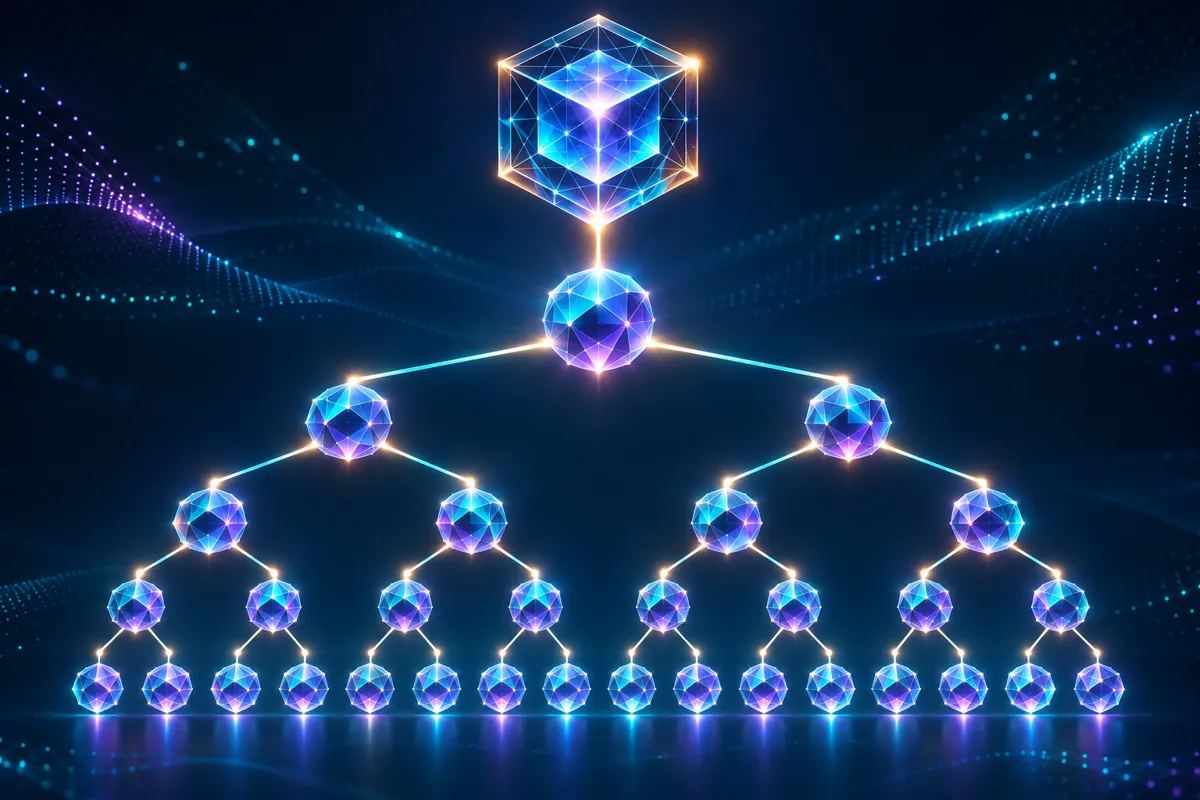
Table of Contents
Every NFT minted on Solana used to need its own account, and every account costs rent in SOL to keep on the chain. For a single piece of art that is a trivial cost. For a collection of ten thousand pieces, or an airdrop to a hundred thousand wallets, that cost adds up fast. Compressed NFTs, often shortened to cNFTs, were built to solve exactly this problem.
How a Regular NFT Is Stored
A standard NFT on Solana is its own on chain account. The account holds the mint address, the owner, and a pointer to the metadata, usually a JSON file kept on IPFS or Arweave. Every account needs enough SOL deposited to cover rent for as long as it exists. Multiply that by a collection size and the storage cost alone can run into real money before a single piece sells.
What Changes With Compression
Instead of giving each NFT its own account, a compressed collection stores its data as a Merkle tree. A Merkle tree is a structure where many pieces of data are hashed together in pairs, over and over, until a single hash, called the root, represents the whole set. That one root hash lives on chain. The actual NFT data, such as ownership and metadata references, is kept off chain but can be mathematically proven against the root at any time.
The practical effect is that a single on chain account, the tree, can represent millions of NFTs instead of one. Industry estimates put the savings at up to 99 percent compared to minting the same collection the regular way, though exact numbers depend on tree size and configuration.
The Role of the Bubblegum Program
On Solana, compressed NFTs are managed through Metaplex’s Bubblegum program. Minting, transferring, or burning a cNFT means sending an instruction through Bubblegum, which updates the Merkle tree and emits the change as transaction data rather than as a new account. This is what keeps the on chain footprint so small.
Why You Need an Indexer
There is a tradeoff behind the savings. Because compressed NFT data is not stored in a normal account, a wallet or app cannot just query it the usual way. Instead, specialized indexing services read every Bubblegum transaction, reconstruct the current state, and serve it through an API. If you want to see your cNFTs in a wallet or marketplace, that wallet or marketplace has to support one of these indexers.
This is the main thing to understand before choosing compression for a project. Your NFTs are just as real and just as provably owned, but reading them depends on infrastructure outside the base Solana chain itself, rather than on the validator network alone.
Where Compressed NFTs Show Up
- Large airdrops. Projects that want to distribute tokens to tens or hundreds of thousands of wallets use compression to keep the cost manageable.
- Loyalty and attendance programs. Collecting a token at every event or purchase only makes sense economically if each mint costs a fraction of a cent.
- In game assets. Games that mint many items, skins, or achievement badges benefit from the same low per unit cost.
- Community and membership drops. Free or low cost membership passes handed out at scale often use cNFTs rather than standard mints.
What to Check Before You Mint Compressed
Compression is not automatically the right choice for every collection. A few things worth checking first:
- Marketplace support. Not every marketplace displays or lets you trade compressed NFTs the same way as standard ones. Check that your target marketplace supports the format before you commit a collection to it.
- Decompression options. Some tooling allows converting a cNFT back into a standard NFT later if you need full account level ownership for a specific use case, such as using it as collateral.
- Collection size and intent. For a single one of one artwork, the gas savings of compression are negligible and the extra complexity may not be worth it. Compression earns its keep at scale.
The Bigger Picture
Compressed NFTs do not change what an NFT fundamentally is. Ownership is still recorded, still verifiable, and still yours to transfer or sell. What changes is where and how that record is stored, trading a bit of reliance on indexing infrastructure for a dramatic cut in minting costs. For collections, airdrops, or games that need to mint at volume, that tradeoff is usually worth it.
If you are getting started with your own NFT project, Simple NFT Creator helps you prepare artwork, mint, and manage collections from your phone. It is available on the App Store and Google Play.